



HOW TO AUDIT WHAT ALEXA FOR SHOPPING KNOWS ABOUT YOUR PRODUCT
Amazon’s AI assistant answers shopper questions using your listing data. When a field is blank it estimates, and when two of your surfaces disagree it picks one without asking you which. Most sellers have never read what it says about their own products. Below is a five-step audit you can run on any ASIN this week, and the fixes for what you will find.
The shelf you cannot rank onto
On May 13, 2026, Amazon renamed Rufus to Alexa for Shopping and merged it with Alexa+. The assistant now takes questions in the main search bar, writes category overviews, builds side-by-side comparisons and carries context across Echo devices and the app. No Prime membership or Echo hardware is required to encounter it.
The scale comes from Amazon’s own reporting. Rufus was used by more than 300 million customers in 2025 and credited with roughly $12 billion in incremental annualized sales. In Q1 2026 monthly active users grew over 115% year over year, with engagement up close to 400%.
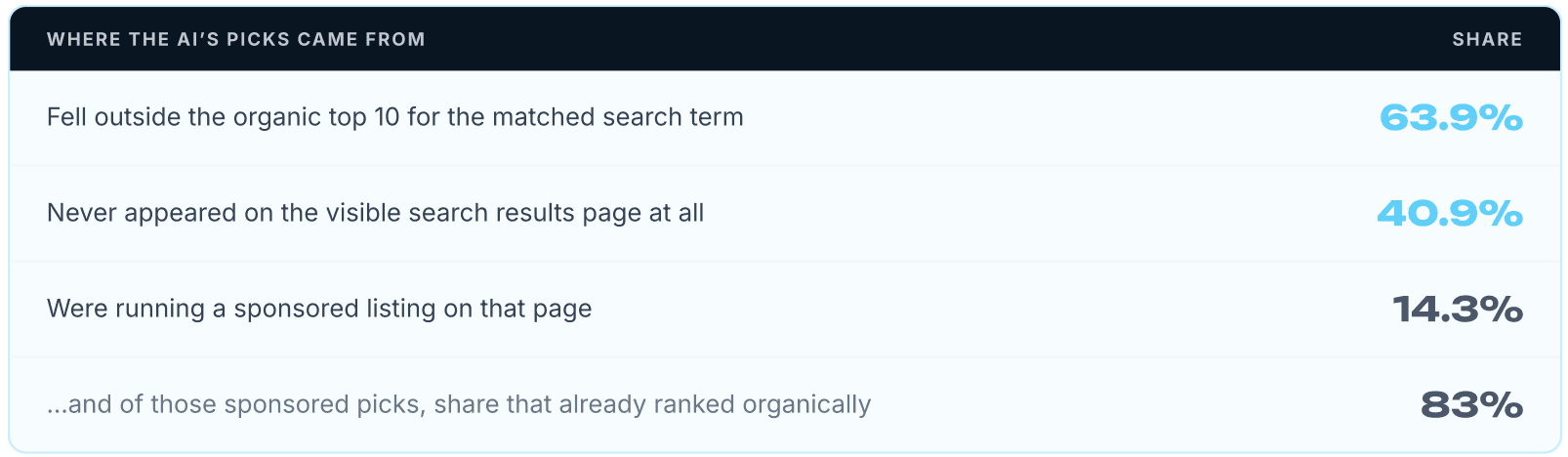
In July 2026 Marketplace Pulse published research across 1,963 non-branded queries and 12,810 recommendations captured in May and June. Asked to recommend products instead of list them, the assistant reached deep into the catalog.

Why a wrong answer costs more here than on Google
You have watched AI answers eat clicks on Google, where zero-click searches reached roughly 68% of queries in early 2026 and organic clicks fall about 38% on results where an AI Overview appears. Amazon runs the other way. Marketplace Pulse measured US Amazon sessions on Black Friday 2025 and found sessions ending in a sale up 100% year over year when the assistant was used, against 20% for sessions without it.
On Google the AI answer substitutes for the click. On Amazon it shortens the distance to checkout, which puts the cost of a wrong answer directly onto your conversion rate.
Amazon has been specific about what the assistant reads. Since the February 2024 launch post the documented inputs have been listing details, customer reviews, community Q&As, and information from across the web. Three of those four are surfaces you own or influence. What Amazon has never published is a ranking formula: no scoring model, no weighting, no API. Any vendor selling "Rufus optimization" with a ranking promise is selling a guess.
You cannot optimize the answer, but you can optimize the inputs it gets built from and then verify the output.
Three ways product data fails
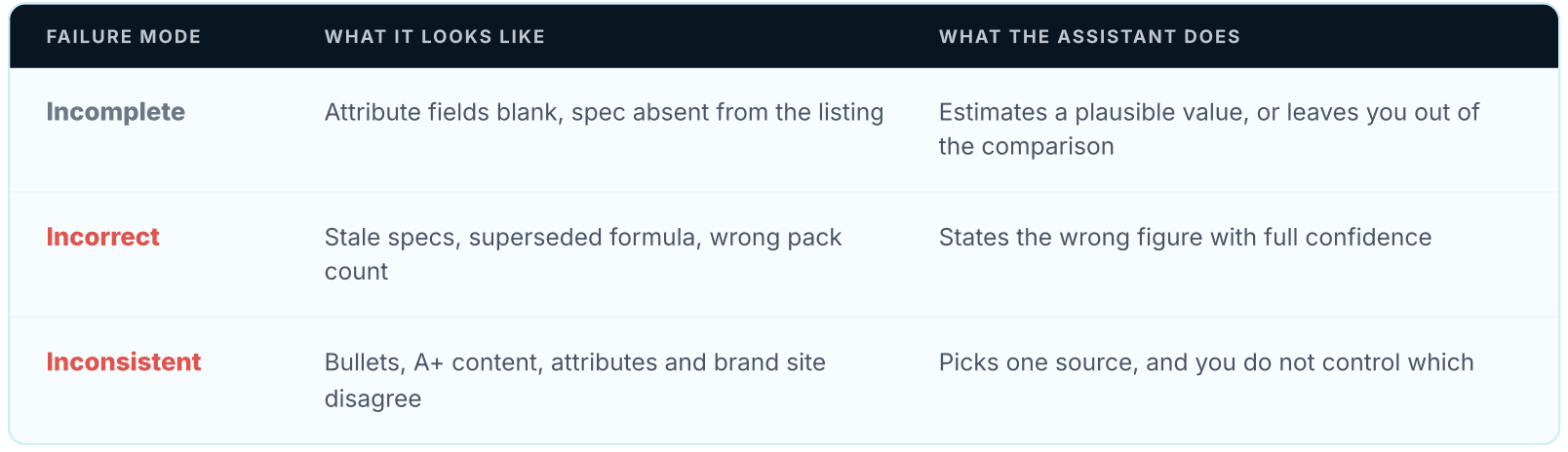
None of this is unusual. Our audits keep finding more than half of a brand’s live content wrong across its Amazon portfolio, and roughly half of the backend attribute fields left empty. The assistant narrows a fifty-product results page down to about five named products, so half your content wrong and half your attributes blank is a poor position to compete from.
The five-step audit
Steps 1, 2, 3 and 5 take about 70 minutes combined per ASIN. Step 4 varies with what you find. Twenty to thirty questions per ASIN is enough to find the real gaps, and quarterly is a sensible cadence after the first cycle.
The order matters. Most AI audits go straight to asking the assistant questions, which only catches the errors it happens to repeat back to you. Step 1 is what makes the other four mean anything.
Step 1 — Build the knowledge map (30 min per product family)
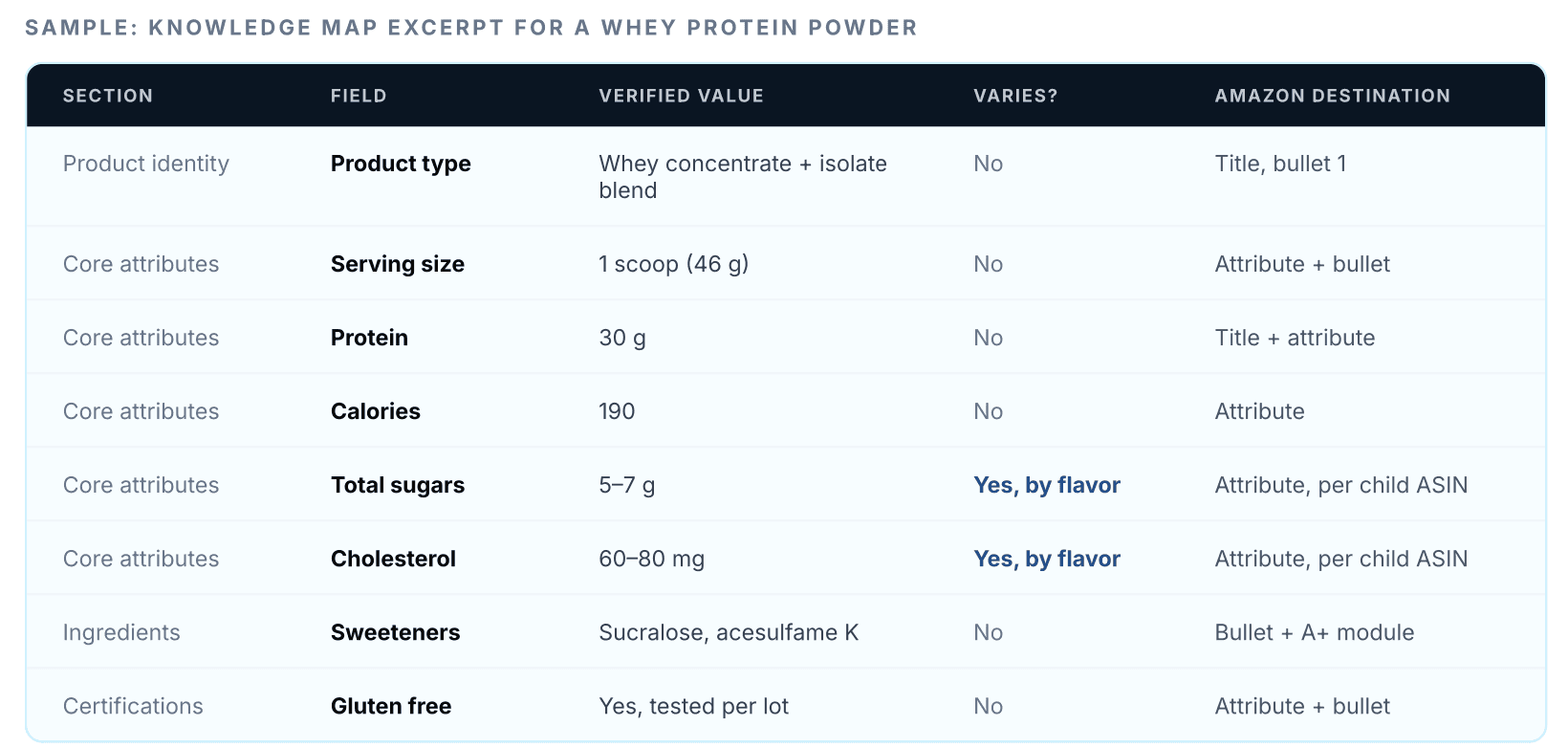
The knowledge map is one row per verifiable fact about the product. You cannot grade an answer without knowing the right answer, so nothing downstream works without it.
Build it from primary sources: the physical label, the manufacturer spec sheet, certificates of analysis, packaging artwork and the brand’s technical documentation. Do not build it from the Amazon listing. The listing is the thing you are auditing.
Six columns do the job: section, field, verified value, whether it varies by variation, and the Amazon field it belongs in. That variation flag matters more than it looks. On one whey protein powder, protein and calories held constant across every flavor while cholesterol, total fat, saturated fat, fiber and sugar all moved. A map recording a single value for those fields will grade a correct answer as wrong.
Step 2 — Diff the listing against the map (10 min per ASIN)
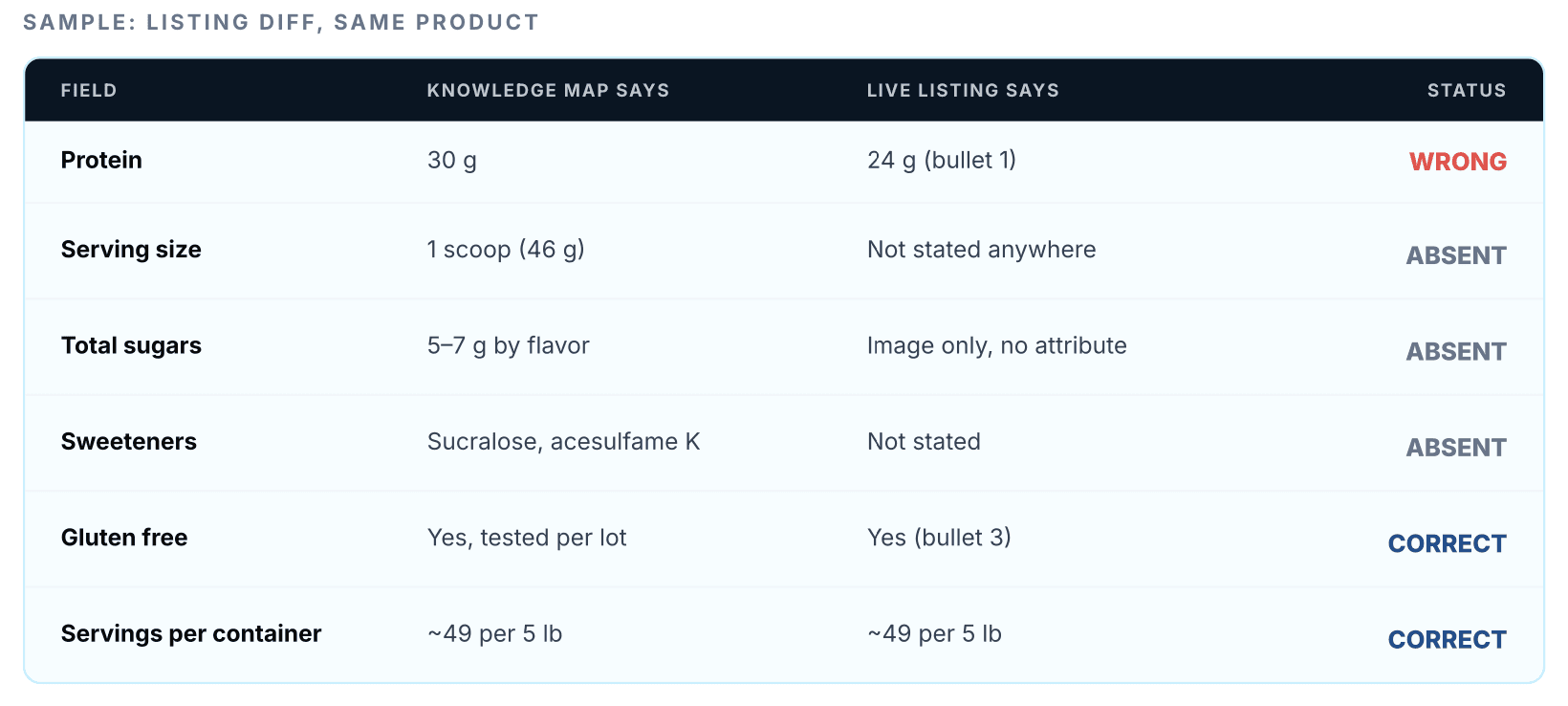
Work through the map field by field and mark each one correct, wrong, absent or inconsistent. This is the step question-only audits skip, and skipping it leaves a hole: when your listing states something false and the assistant happens to answer correctly from a different source, the false claim survives the audit and keeps feeding future answers.
The first bullet on one live listing claimed 24 g of protein per serving. The nutrition panel, the title on that same listing and the brand website all said 30 g. The arithmetic settled it: the brand advertises a 65% protein yield, and 30 g divided by the 46 g scoop is 65%. Asked directly, the assistant answered 30 g. Correct. A question-only audit would have marked that green and moved on while a false number sat in the most-read line of the listing, waiting to be picked up next time.
Count your attribute fill rate on the same pass. Treat 90% as the floor for any ASIN doing meaningful revenue.
Step 3 — Interrogate the assistant (15 min per ASIN)
Get a clean context first. Alexa for Shopping personalizes answers using account history. In one audit the reply included the phrase "especially paired with your interest in amino cuts and glutamine" — the tester’s own browsing history bleeding into what was meant to be a neutral test. Answers captured that way cannot be reproduced, and they poison step 5: when the re-run comes back different, you have no way to tell whether your fix worked or the account learned something new.
Run the audit logged out, or from a clean account with no purchase history in the category. Capture from two or three contexts when the ASIN matters, and note the variance. Screenshot and timestamp everything.
Cover five question buckets:
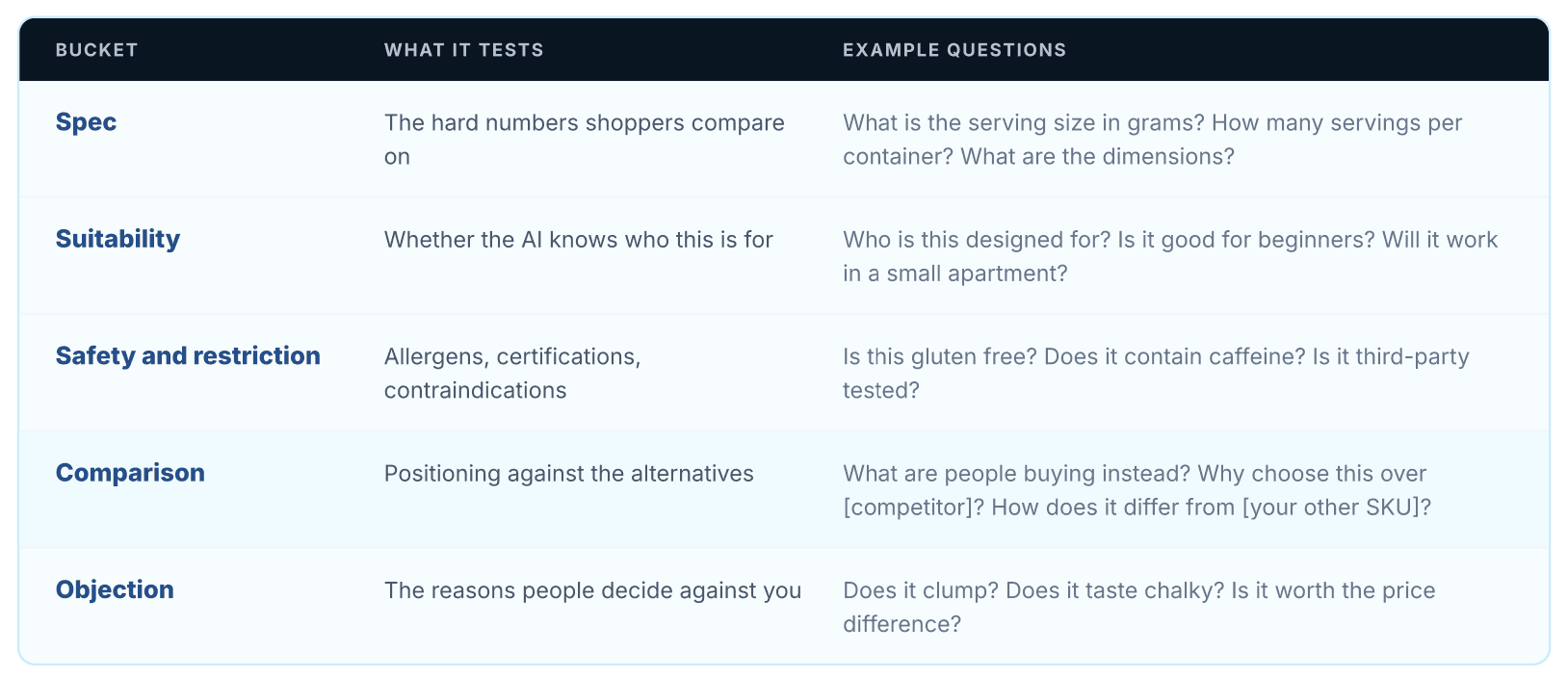
Comparison is the bucket sellers skip, and it surfaces positioning gaps that spec questions never reach.
Then grade every answer on four levels. A three-level confidence score collapses two very different problems into one bucket.
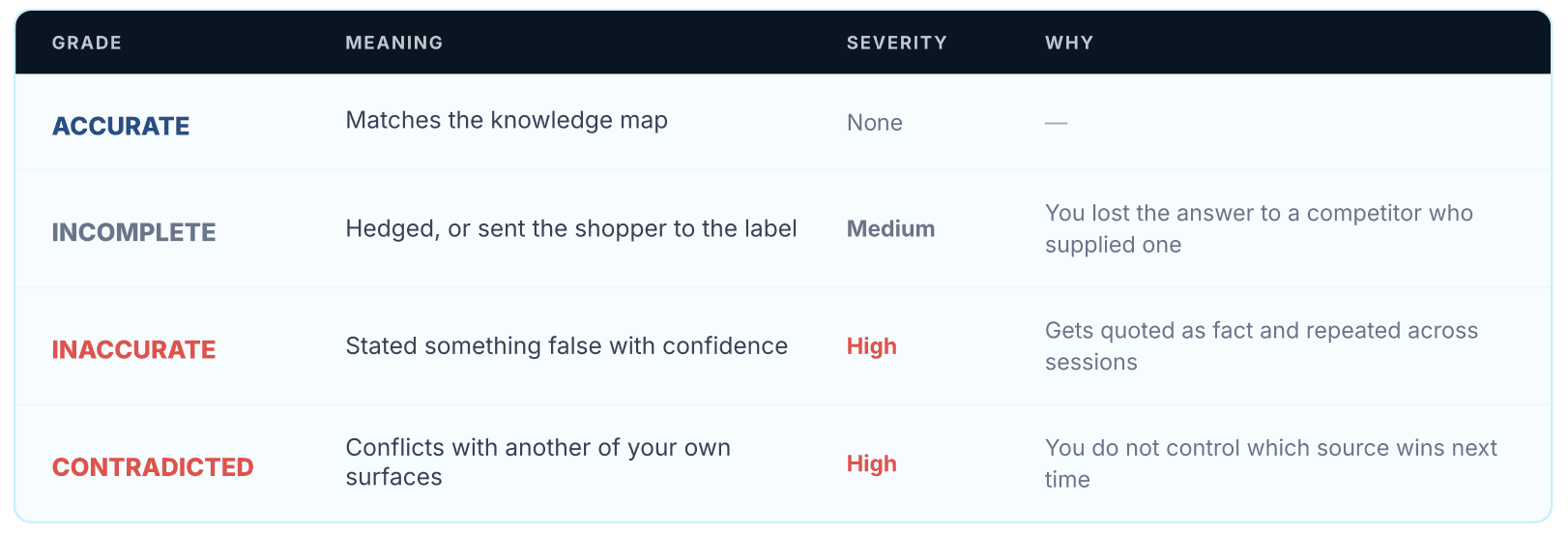
A hedge and a confident wrong number are different problems. A hedge sends the shopper to the label, and you lose the answer to whichever competitor supplied one. A confident wrong number gets quoted as fact and repeated across sessions.
Asked for serving size in grams, the assistant answered "approximately 33–36 grams." The actual scoop is 46 g. At 46 g a 5 lb tub holds about 49 servings; a shopper working from 34 g calculates 66. That is 35% more servings than exist, which makes the cost per serving look 35% cheaper than it is. The error flatters the product at the moment of comparison and then disappoints after delivery, which is how you buy yourself a two-star review.
Add two columns while you grade. Suspected source records where the answer probably came from: attribute, bullet, A+ module, review, Q&A or open web. Without it, step 4 is guesswork. Severity records whether the question sits on the path to purchase.
Step 4 — Fix at the source (varies)
Route each failure to the field that caused it:
Inaccurate, where the assistant estimated a value you never stated → structured attribute fields first, then a bullet
Contradicted, where it repeated something false from your copy → the bullet, description or A+ module carrying it
Contradicted, where the spec it cited matches your brand site instead of your listing → reconcile both, then correct whichever one is wrong
Incomplete, where it declined to answer a common question → community Q&A, answered by the brand with a specific figure
Incomplete, where it described your product for the wrong audience → make audience and use case explicit in bullets and A+ content
Attributes come before copy. Amazon’s own listing model infers unstated attributes and can get that wrong, reading a diameter and concluding a table is round. Complete fields leave nothing to infer. Everything else here is ordinary listing optimization work, now with a second audience reading it.
Reviews are a documented input too, and Amazon builds its AI review highlights only from verified purchases. When recurring complaints contradict your copy, the assistant has two versions of your product to choose between, so steady review generation belongs in the same workstream.
Two more things to handle in the same pass.
Open the Prompts tab in your Ads Console. Sponsored Products and Sponsored Brands prompts reached general availability on March 25, 2026, US-only, with existing campaigns auto-enrolled and billed under existing CPC parameters. AI-generated prompts have been speaking on your brand’s behalf ever since, reviewed or not. Amazon reports that nearly 20% of shoppers who interact with a prompt continue the conversation about that brand, and that adding prompts to a Sponsored Brands ad drives a 6% lift in conversions. Read them, pause anything off-brand, and fold the review into your regular advertising audits.
Then reconcile with the title change. Since July 27, 2026, titles in most categories have capped at 75 characters, with a new 125-character Item Highlights field carrying the overflow. Non-compliant titles get rewritten by Amazon’s model on Amazon’s schedule, and only brand-registered sellers get a 14-day review window. That migration pushes exactly the detail the assistant quotes out of titles and into Item Highlights and bullets. Run the two projects as one.
Step 5 — Re-run and measure (~15 min)
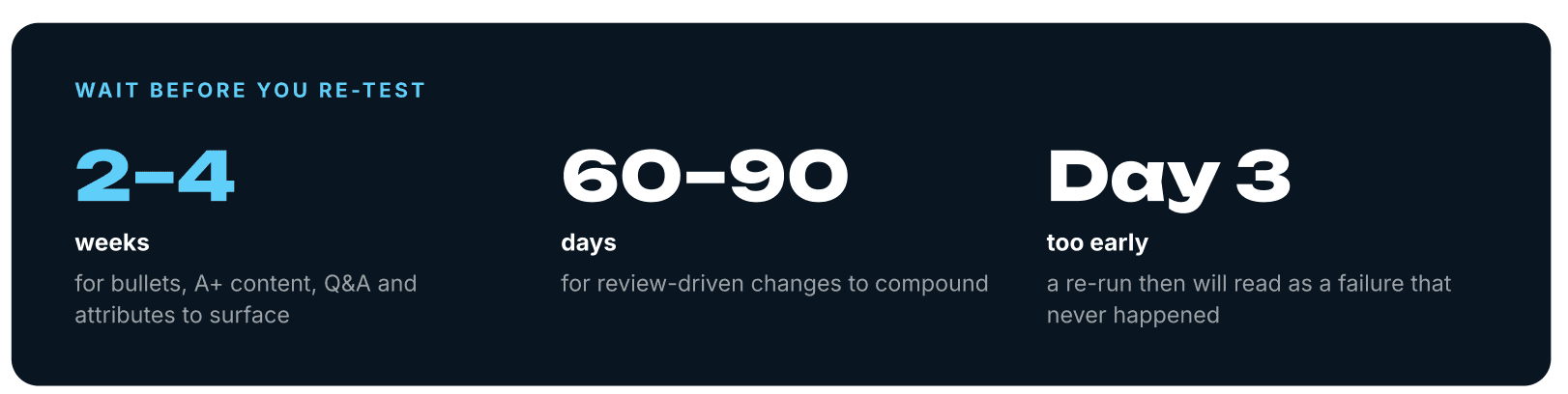
Wait before you re-test. Bullets, A+ content, Q&A and attributes need two to four weeks to surface. Review-driven changes need 60 to 90 days to compound. A re-run on day three will read as a failure that never happened.
Then run the identical question set, worded identically, from the same clean context, and score it the same way. Your scorecard is the deliverable: count the answers in each grade before and after. Target zero Inaccurate and zero Contradicted without exception, zero Incomplete on spec and safety questions, and Accurate on everything sitting on the path to purchase.
That before-and-after count is also the clearest thing you can put in front of a finance director. After the first cycle, go quarterly, plus a re-run whenever the formula, packaging, pack count or certification changes.
What this method will not tell you
Being straight about the limits is what makes the rest of the work credible.
There is no published formula and no API. Amazon has blocked AI crawlers from the site, so every third-party "AI visibility" tool works around that with simulated queries or panel data. Treat their numbers as directional.
COSMO is unconfirmed. Amazon’s commonsense knowledge graph is widely claimed to power the assistant, but Amazon has never confirmed it and Amazon’s own COSMO paper does not mention Rufus. Ignore anyone selling COSMO optimization.
Two figures circulate that we could not trace and do not use: that listings with fifteen or more answered Q&As appear in recommendations 3.2 times more often, and that AI optimization delivers conversion lifts of 20–35%. Both are repeated across optimization blogs with no originating evidence.
And a point of proportion. The assistant still accounts for a minority of product discovery on Amazon. Most shoppers arrive through search results and ads, so keyword work, share of voice and ad structure all continue to matter. The case for doing this now is that the work is cheap while the surface is young, and every fix improves the listing for human shoppers anyway.
Final word
Every seller believes their listing is accurate. Audit work keeps finding more than half of live content wrong across whole portfolios, which means the belief is usually mistaken and almost never tested.
The assistant will keep gaining surfaces. The search bar, category overviews, comparisons, Echo devices and whatever ships next all read from the same product data you already own. You cannot control which products it recommends, and the Marketplace Pulse study suggests neither rank nor ad spend buys you in. What you do control is whether the picture it holds of your product is complete, correct and consistent.
Want your top ASIN run through this method? Our creative optimization work starts with exactly this audit. Book a 30-minute read-out (See Calendar Below) and we will walk your scorecard through with you.


EXPLORE MORE



Make an impact?
Let's connect
Let’s turn your goals into growth.
Whether you're scaling your brand or seeking expert guidance, we're here to make it happen — smarter and faster.
Let’s build something remarkable together.